Story by Chris Beaudin / April 2, 2026
Every time a construction project changes hands (from architect to engineer, from engineer to GC, from GC to subcontractor) something gets lost.
Not always something visible. Sometimes it’s just a degree of ownership. A slight dilution of accountability. A gap where “I assumed they handled that” quietly lives until it doesn’t.
Those gaps are expensive. And in industrial and commercial construction, they’re structural… built into how most firms are organized.
The Handoff Problem in Commercial and Industrial Construction
The traditional design-bid-build model treats construction as a series of sequential transactions. Design firm hands drawings to engineer. Engineer sends specifications to GC. GC distributes scope to subs. Each handoff is a translation, and every translation risks losing something in the conversion.
By the time an industrial facility or commercial building is under construction, the team executing it often had no meaningful role in designing it. The GC who wasn’t in the room during schematic design doesn’t fully understand the design intent. The design team that’s off the project by the time steel goes up can’t adapt when field conditions change. The owner managing multiple vendors instead of one accountable design-build partner spends more time mediating than building.
These aren’t character flaws. They’re structural problems, and they have structural solutions.
What In-House Design-Build Really Means
A lot of firms claim integrated delivery. Fewer actually mean it.
At BEHKO, in-house means our architects, structural engineers, and construction crews work under one roof, on every industrial and commercial project, from day one. Our engineers are construction specialists. They don’t just develop structural systems, they understand exactly how those systems get built, what they cost in the field, and what the schedule implications are.
That dual fluency (between design thinking and construction reality) is what separates expertise from coordination. When your structural engineer is embedded in your project management, there’s no translation layer. Design intent becomes construction reality without the telephone game in between.
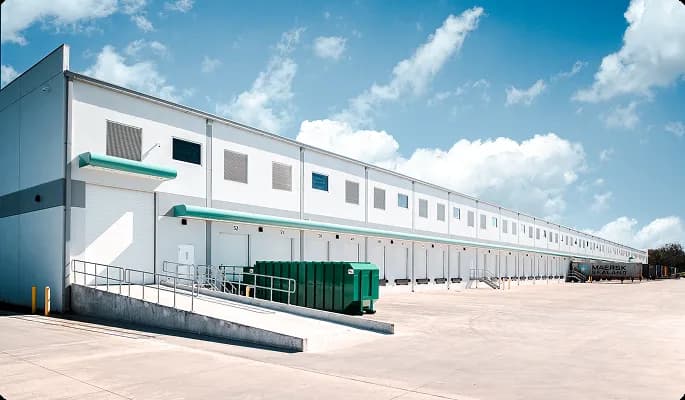
Consider the Frontier Logistics 555,000-square-foot warehouse in North Charleston. Serving as both general contractor and chief architect, our in-house team developed a recessed downspout system along the truck court, a purpose-built solution to reduce damage from trucks backing into loading docks. That kind of field-informed design thinking doesn’t happen when design and construction are separate organizations communicating through drawings. It happens when they’re the same team.
All A-Players, No Gaps, No Guessing
We’re selective about the design-build construction projects we pursue, by design. We compete for complexity: sophisticated industrial manufacturing facilities, commercial logistics hubs across the Charleston and Savannah port corridors, healthcare and regulated environments, adaptive reuse projects across the Lowcountry.
Those projects don’t reward average. They demand deep technical understanding at every stage. So we staff them accordingly, with engineers and construction leaders who have done this work before and understand exactly where it breaks down.
No handoffs. No gaps. No guessing. Just expertise everywhere.
Hi, we’re the BEHKO Group, a design-build construction firm headquartered in Charleston, SC. Industrial and commercial construction across South Carolina and Georgia (architecture, engineering, and construction all in-house).



 Behko Spotlight